S91BOX AML & KYC Policy
Purpose of the AML & KYC Policy
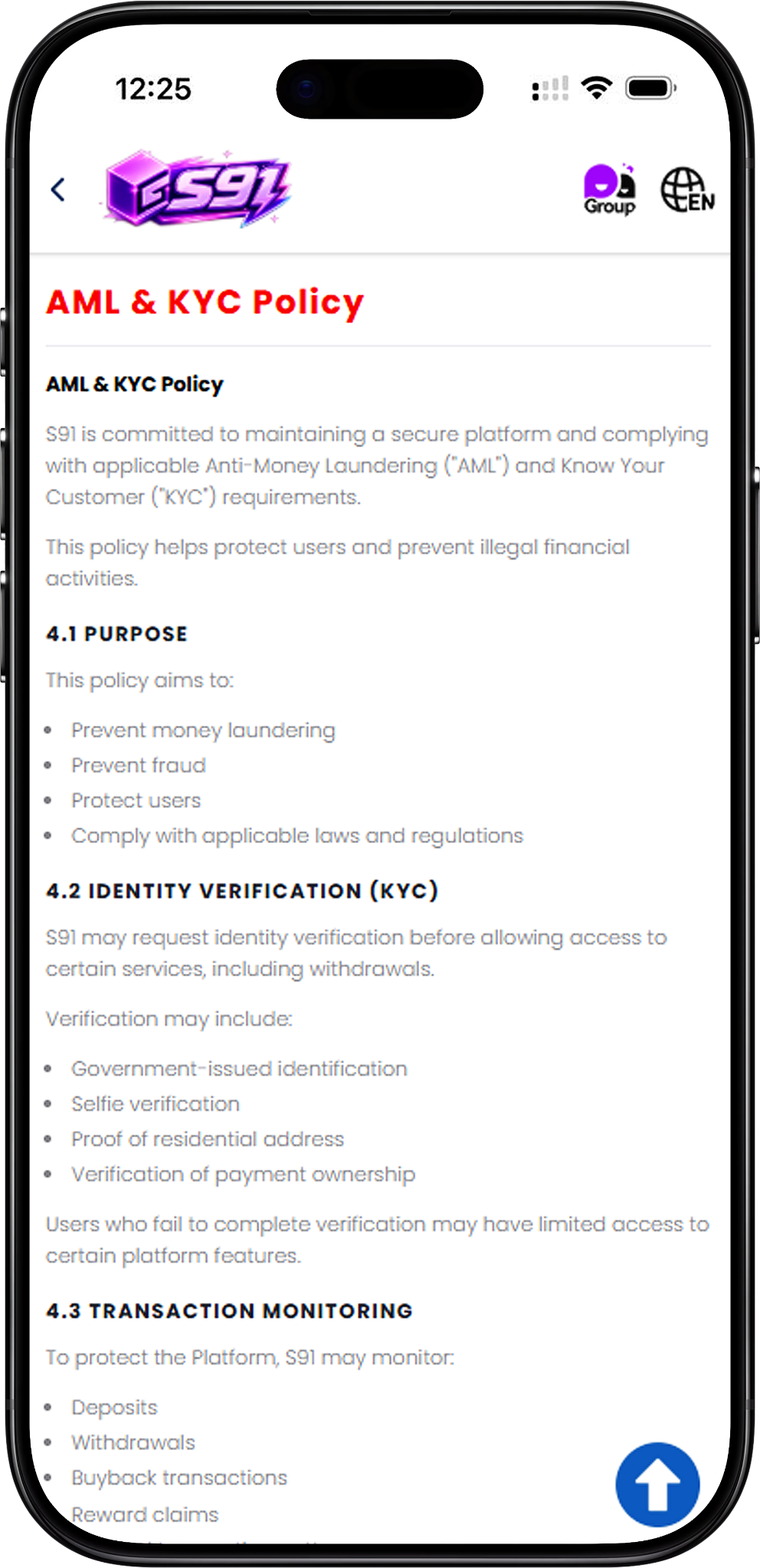
The S91BOX AML & KYC Policy establishes measures intended to help prevent money laundering and fraud, protect users, and support compliance with applicable laws and regulations.
Prevent Money Laundering
S91 applies AML-related measures to help identify and prevent activities that may involve money laundering or other illegal financial conduct on the Platform.
Prevent Fraud
The policy supports fraud prevention by allowing S91 to verify users, monitor relevant transactions and review activity that may appear suspicious or fraudulent.
Protect Platform Users
Identity verification and transaction monitoring can help protect users by reducing risks associated with unauthorized, deceptive or suspicious financial activities.
Comply With Applicable Requirements
S91 is committed to complying with applicable AML, KYC and other legal or regulatory requirements relevant to Platform operations.
Identity Verification (KYC)
When S91 May Request KYC
S91 may request identity verification (KYC) before allowing access to certain Platform services, including withdrawals. Users who do not complete required verification may have limited access to certain Platform features.
Government-Issued Identification
KYC verification may require a valid government-issued identification document so S91 can verify the identity information associated with the user.
Selfie Verification
Users may be asked to complete selfie verification as part of the identity verification process. This may be used together with other supporting information requested by the Platform.
Proof of Residential Address
S91 may request proof of residential address where required for KYC verification. Users should provide the supporting documentation requested through the applicable verification process.
Verification of Payment Ownership
KYC checks may include verification of payment ownership. This allows S91 to review whether relevant payment information is associated with the user undergoing verification.
Incomplete KYC Verification
Users who fail to complete required identity verification may have limited access to certain S91 features or services. The specific restriction depends on the verification requirement involved.
Transaction Monitoring
S91 may conduct transaction monitoring to identify unusual, suspicious or potentially fraudulent behaviour. Monitoring can cover several types of Platform activity rather than being limited to a single transaction type.
Deposits
Deposit activity may be monitored as part of S91’s measures for identifying suspicious transaction behaviour and protecting the Platform.
Withdrawals
Withdrawal activity may be reviewed to identify suspicious or unusual transaction patterns. Identity verification may also be required before access to withdrawal services is permitted.
Buyback Transactions
S91 may monitor Buyback transactions as part of its transaction monitoring and risk-control measures.
Reward Claims
Reward claims may be monitored where necessary to identify suspicious or fraudulent activity involving Platform rewards.
Unusual Transaction Patterns
S91 may review unusual transaction patterns that could indicate fraud, abuse, money laundering or other suspicious financial activity.
Multiple Account Activities
Multiple account activity may be monitored as part of S91’s fraud and risk controls. Activity involving multiple accounts may be reviewed where it indicates suspicious or abusive behaviour.
Risk Review
When suspicious activity is detected, S91 may conduct a risk review and apply additional measures to protect users and the Platform. The action taken may depend on the circumstances and identified risk.
Request Additional Supporting Documents
S91 may request additional supporting documents when more information is needed to review a user, account or transaction.
Delay Transaction Processing
Transaction processing may be delayed while S91 performs verification or reviews activity identified as potentially suspicious.
Reject Withdrawals
S91 may reject a withdrawal when suspicious activity or another relevant risk is identified during its review.
Temporarily Freeze Accounts
An account may be temporarily frozen where S91 considers this necessary as part of a risk review or protective measure.
Suspend Platform Access
Platform access may be suspended when suspicious activity requires further review or when S91 determines that additional protective measures are necessary.
Record Retention
Transaction Records
S91 may retain transaction records for as long as required by applicable laws or legitimate business purposes. These records can support compliance, security and transaction review requirements.
Verification Documents
Identity verification documents may also be retained where required by applicable laws or legitimate business purposes. The retention period therefore depends on the applicable requirement or purpose.
AML & KYC Compliance
Cooperation With Regulatory Authorities
S91 reserves the right to cooperate with regulatory authorities where required by law. This may include actions necessary to satisfy applicable legal and regulatory obligations.
Fraudulent or Illegal Activities
Users found engaging in fraudulent, illegal or money laundering activities may have their accounts suspended or permanently terminated.
User Responsibility
Users should provide accurate information and cooperate with applicable verification requirements when requested. Failure to complete required verification may result in restricted access to certain Platform services.
AML & KYC Policy Updates
S91 may update its AML & KYC Policy from time to time. The latest version will be made available on the Platform so users can review the current verification, monitoring and compliance requirements.
Review the Latest Policy
Users should refer to the latest published version of the policy when reviewing current AML and KYC requirements, as Platform procedures may be updated to reflect applicable compliance needs.
S91BOX AML & KYC Policy FAQ
What is the S91BOX AML & KYC Policy?
It describes S91’s measures for identity verification, transaction monitoring, risk reviews, record retention and compliance with applicable Anti-Money Laundering and Know Your Customer requirements.
Why does S91BOX use AML and KYC measures?
The policy is intended to help prevent money laundering and fraud, protect users, and support compliance with applicable laws and regulations.
When can S91BOX request identity verification?
S91 may request identity verification before allowing access to certain services, including withdrawals.
What documents can be required for KYC?
Verification may include government-issued identification, selfie verification, proof of residential address and verification of payment ownership.
What happens if I do not complete KYC?
Users who fail to complete required verification may have limited access to certain Platform features.
What transactions can S91BOX monitor?
S91 may monitor deposits, withdrawals, Buyback transactions, reward claims, unusual transaction patterns and multiple account activities.
What can happen if suspicious activity is detected?
S91 may request additional documents, delay transaction processing, reject withdrawals, temporarily freeze accounts or suspend Platform access.
Does S91BOX retain verification documents?
S91 may retain verification documents and transaction records for as long as required by applicable laws or legitimate business purposes.
Can S91BOX cooperate with regulatory authorities?
Yes. S91 reserves the right to cooperate with regulatory authorities where required by law.
What can happen to accounts involved in money laundering or fraud?
Users found engaging in fraudulent, illegal or money laundering activities may have their accounts suspended or permanently terminated.
Can the AML & KYC Policy be updated?
Yes. S91 may update the policy from time to time, and the latest version will be available on the Platform.
Review the S91BOX AML & KYC Requirements
Understand S91’s identity verification, transaction monitoring and compliance requirements before using services that may require additional verification.